

According to a new study, organizations that use first-party data for personalization grow 2.5 times more in revenue than organizations that rely heavily on third-party data. Certainly, this paradigm shift will change the face of data-driven marketing, with the disappearance of third-party cookies and tightening privacy regulations. Marketers are facing one critical question: which data truly drives better personalization—first-party or third-party?
But obviously, the answer isn’t black and white. Each type of data has its own advantages and disadvantages, and which one you choose will be based on your business goals, target audience, and available resources. This blog will explore the grey area between first-party and third-party data while providing actionable insights on the path for marketers to follow in making informed decisions. Whether you are looking at deepening customer relationships or expanding your reach, understanding how to leverage these data types will be central to future-proofing your strategy.
What is First-Party Data and Why Does It Matter?
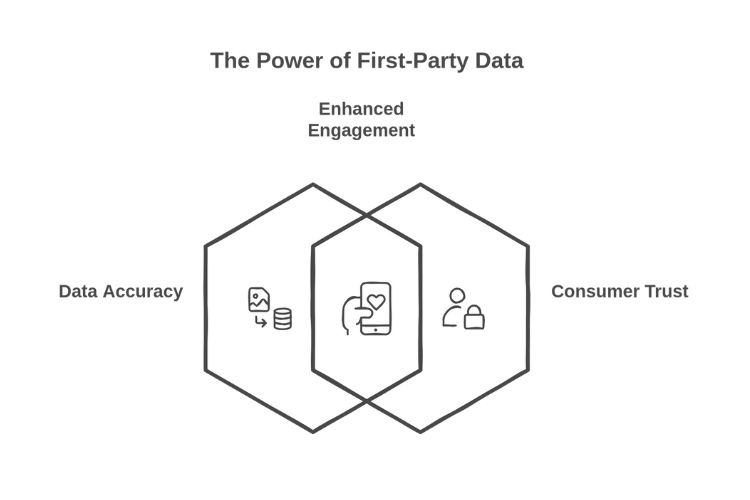
First-party data is the information you collect directly from your audience based on their interactions with your brand. This comprises visitors to your website, an email sign-up, purchase histories, app usage, and customer feedback. First-party data that you possess represents your customers’ actual behavior and preferences, unlike unreliable third-party sources that represent other people’s observations.
First-party data is so valuable because it is precise. Data that has been extracted directly from the customers themselves attain granularity that third-party data can never achieve. For example, Spotify uses first-party data to create personalized playlists like Discover Weekly, which drove up user engagement by 20%. An analysis of listening behaviors allows Spotify to send hyper-relevant content that keeps users coming back.
In marketing, first-party data is not only about personalization but also about trust. In a world filled with privacy concerns, customers are more inclined to share their data with brands they trust. Trust can be built through transparency in how you collect and use their information, thus developing more meaningful relationships with your audience. To fully capitalize on first-party data, some investment in CRM platforms and analytics software would be essential. These tools can help organize and analyze the customer data efficiently and easily convert raw information into actionable insights. For example, HubSpot or Salesforce centralized systems for data would make it simple to analyze customer journeys and adapt your marketing endeavors.
Read: The Rising Demand for Rotating Residential Proxies in Digital
The Role of Third-Party Data in Personalization
Although the first-party data forms the foundation for personalized marketing, the use of third-party data helps in extending the reach of your marketing effort and in discovering new opportunities. Let us discuss in detail what third-party data is, its strengths, weaknesses, and effective use.
What is Third-Party Data?
The information is acquired by an outside party, which may include data brokers, publishers, or aggregators, and sold to companies. They usually contain demographic information, browsing activity, and purchase intent signals from numerous sources. Unlike first-party data, collected directly from your audience, third-party data provides a much more extensive view of possible customers, but not as particular.
Strengths of Third-Party Data
One of the key strengths of third-party data is its ability to help you target new customer segments. For example, a SaaS company like HubSpot might use third-party data to identify potential leads in industries they haven’t yet tapped into. By analyzing broader trends and behaviors, third-party data can provide valuable insights into untapped markets or emerging customer needs.
Limitations of Third-Party Data
Yet, its shortcomings arise from the unsolicited nature of its data-gathering processes. Third-party data aggregates information from many sources; therefore, it is considered less accurate and less specific than first-party data. With privacy challenges and regulatory changes, such as third-party cookie deprecation, it is getting increasingly difficult to work with this type of data. For example, Apple’s App Tracking Transparency framework and Google’s plan to retire third-party cookies mean there has been decreased availability and reduced reliability of third-party data.
How to Use Third-Party Data Effectively
The key to effectively using third-party data is not to replace first-party data but to use it as a supplement. You can consider it as a gap-filling element in understanding larger audiences or opening up new markets, but always check for the validity of the source and compliance with privacy laws such as GDPR or CCPA. You can, for instance, collect third-party data to create lookalike audiences for your advertising, then shift to a first-party focus once a hot lead profile has been developed.
Next we will see that the real power resides in the strategic combination of the two data types. This means that by using the strengths of first-party data and third-party data, one can build a very comprehensive personalization strategy.
Comparing Personalization Outcomes: First-Party vs. Third-Party Data
When it comes to personalization, not all data is created equal. Your choice of first party versus third party data can shape the scope, relevance and effectiveness of your marketing efforts. So, evaluate how different types of data perform on various dimensions of personalization.
- Depth of Personalization
First-party data does shine in terms of depth and accuracy. Since it is data collected entirely from your customers, it allows hyper-personalized experiences that feel utterly tailored and relevant. For example, in the case of an e-commerce brand, first-party data can be used in sending personalized email campaigns featuring products a customer has viewed or purchased recently. Such a level of specificity increases engagement and earns loyalty for your brand by emphasizing your understanding of customers’ preferences.
Third-party data, being more generic in nature, still has some relevance in personalization in the broader sense. For example, an audience might be encouraged based on demographic trends or inferred interests, leading to useful acquisition campaigns.
- Web Personalization
In web personalization, the content, offers, and experiences of a website are adapted for users based on their behavior, preferences, or personal data. By personalizing their experiences, companies engage with their users effectively and thus increasing conversions. Now, web personalization is an area where the two data types differ most significantly.
- First-Party Data in Action
The first-party data provides the engine for the dynamic content, for instance displaying items recently viewed by a customer or offering personalized recommendations conducive to a continuous and engaging user experience. To illustrate, Amazon makes personalized homepages for logged-in users based on first-party data, where product recommendations are based upon browsing history and purchase behavior.
- Third-Party Data in Action:
To personalize experiences for new visitors, third-party data can be applied. For instance, a SaaS company might track third-party data to present industry-specific case studies or offers based on a visitor’s presumed job role or interests. This may be less accurate, but it will still make an impression.
- Customer Trust:
- First-Party Data:
Customers trust first-party data because they communicate their information freely, knowing exactly how it will be used. Clear data practices strengthen relationships and take people a step further towards repeat traffic. - Third-Party Data:
The invasion of third-party data is unethical when it is mishandled. Over-dependency on this kind of data with unclear communication would surely ruin the trust and damage the brand’s reputation.
- First-Party Data:
As per a survey creating personalization features with first-party data produces a revenue lift of 10–15%. This shows that building trust with transparent data practices is important. The bottom line? First-party data should be prioritized for retention strategies, while third-party data is best used for acquisition campaigns. A balanced growth strategy includes both while simultaneously fostering customer loyalty.
Challenges and How to Overcome Them
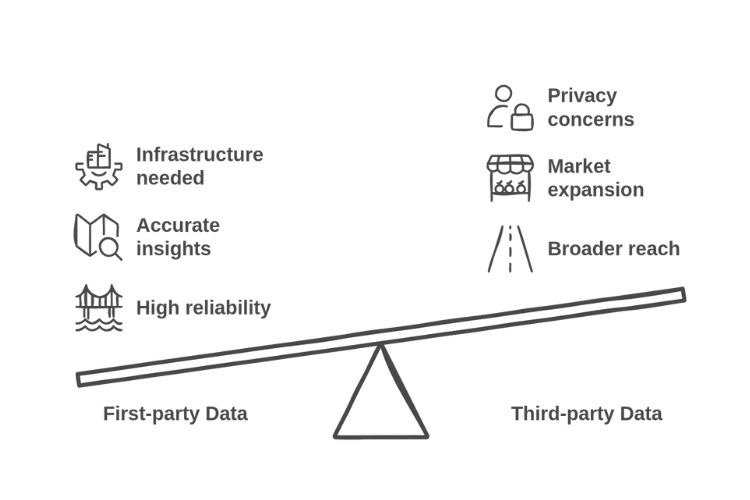
There are drawbacks that come with both first-party and third-party data that can limit their effectiveness in the overall data strategy. First-party data is accurate and credible, but it is limited and reflects only existing customers. It requires strong infrastructure to draw actionable insights. Whereas, third-party data has accuracy and privacy issues, particularly when industry regulations proliferate and third-party cookies are eliminated.
Organizations can find solutions to these hurdles: by using both types of data-user third-party data to identify what new audiences might want and first-party data to create personalized engagement with those audiences. Investing in Customer Data Platforms (CDPs) and web personalization tools will integrate and analyze data and bring an end-to-end approach with future-proof personalization.
Future-Proofing the Data Strategy
Future-proofing your data strategy isn’t a matter of choice anymore; it has become a necessity. With the third-party cookie going away and privacy regulations getting stricter, you will find the old-fashioned ways of data collection won’t leave you time to react. The answer? Shift your focus onto the all-important first-party data. Instead of waiting for data from sources outside, you should start building a direct relationship with your audience.
Encourage users to share their data freely in return for fun experiences, a fully-featured preference center, or through a simple-to-use loyalty program. But data collection alone isn’t enough; there has to be a way of processing and treating that data. And that’s where a robust Customer Data Platform comes in. With a CDP, you’re able to bring all of your data together and activate it a lot faster, customizing the user experience while staying discreet.
Speaking of privacy, compliance with GDPR or CCPA should not be an afterthought; it should be a fundamental part of your strategy. Transparency becomes trust in the manner you collect and use data. Trust builds long-term customer loyalty. Web Personalization AI analytics tools will be instrumental in predicting customer behavior and in scaling the automation of personalization. Today, active investment by brands in direct customer relationships and intelligent data activation will serve them well in the future environment of managing consumer relationships.
Conclusion
The first-party data provides grounds to enable the accuracy and trustworthiness of effective personalization while third-party data extends reach and opens new avenues. The actual strength lies in combining both. First-party data with compliance forms the basis of ethical approaches towards utilizing third-party insights that will further help in keeping pace with industry changes and improving customer relationships.
Author’s Bio:
Vidhatanand is the Founder and CEO of Fragmatic, a web personalization platform for B2B businesses. He specializes in advancing AI-driven personalization and is passionate about creating technologies that help businesses deliver meaningful digital experiences.